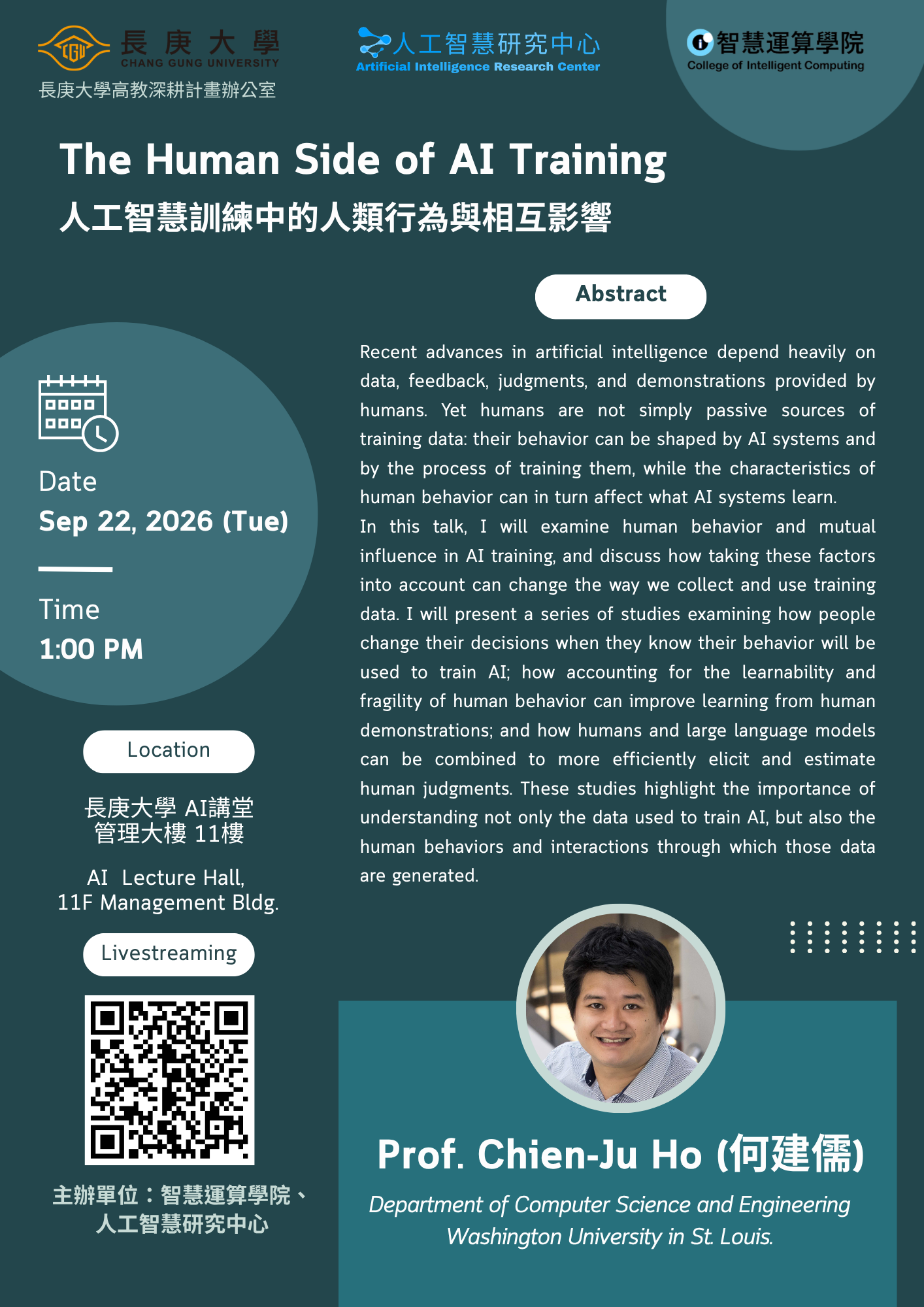
Date & Time: Tuesday, Septermber 22 , 2026, 13:00–15:00
Venue: 11th Floor, Management Building AI Lecture Hall,
Meeting Link: https://reurl.cc/5XD8Kn or
scan the QR code on the poster
About the Speaker:
Chien-Ju Ho is an Associate Professor of Computer Science and Engineering at Washington University in St. Louis. He is currently on sabbatical and serving as a Visiting Associate Professor at Chang Gung University. His research lies at the intersection of machine learning, human-AI interaction and collaboration, human computation, and algorithmic and behavioral economics. In particular, his work examines how human behavior shapes the learning and decision making of AI systems, and how AI systems in turn influence people. His research has appeared in venues including PNAS, ICML, NeurIPS, ACL, NAACL, WWW, AAAI, and AAMAS. He also serves as Program Co-Chair of ACM Conference on Human-AI Complementarity and Alignment (HCOMP) 2026.
Lecture Abstract:
Recent
advances in artificial intelligence depend heavily on data, feedback,
judgments, and demonstrations provided by humans. Yet humans are not simply
passive sources of training data: their behavior can be shaped by AI systems
and by the process of training them, while the characteristics of human
behavior can in turn affect what AI systems learn. In this talk, I will
examine human behavior and mutual influence in AI training, and discuss how
taking these factors into account can change the way we collect and use
training data. I will present a series of studies examining how people change
their decisions when they know their behavior will be used to train AI; how
accounting for the learnability and fragility of human behavior can improve
learning from human demonstrations; and how humans and large language models
can be combined to more efficiently elicit and estimate human judgments. These
studies highlight the importance of understanding not only the data used to
train AI, but also the human behaviors and interactions through which those
data are generated.