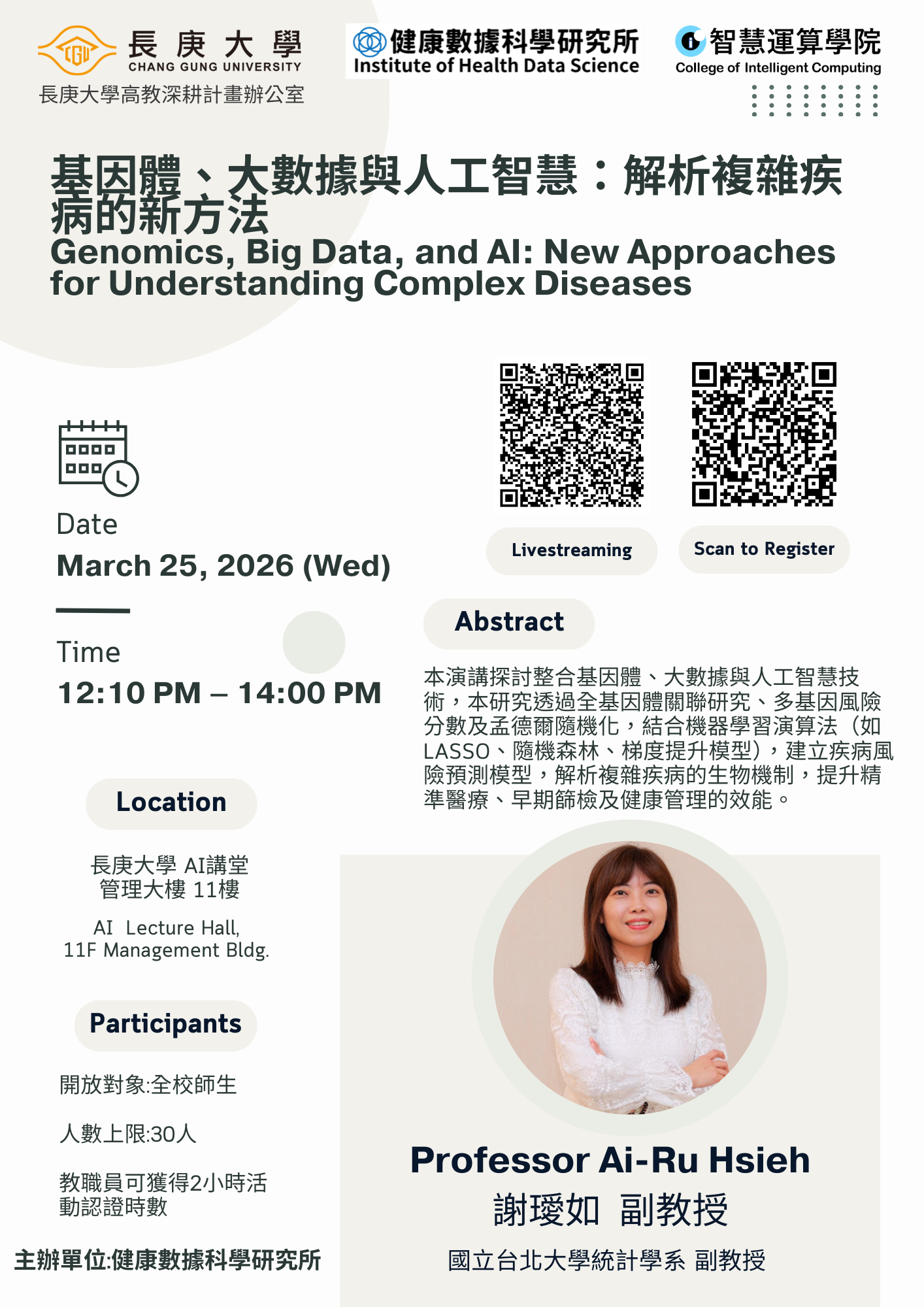

Topic: Genomics,
Big Data, and AI: New Approaches for Understanding Complex Diseases
Speaker: Prof.
AiRu Hsieh — Associate Professor, Department of Statistics, National Taipei
University
Time: March
25, 2026 (Tuesday), 12:10 – 14:00
Venue: The
Management Building, 11F, AI Lecture Hall
Join Online: https://reurl.cc/lpdb2q or scan QR code on poster
Registration: https://forms.office.com/r/iUTLaer75x or scan QR code on poster
About the Speaker:
Professor Ai-Ru Hsieh is a researcher in
statistical genetics and biomedical data science. Her work focuses on
integrating genome-wide association studies (GWAS), polygenic risk scores
(PRS), Mendelian randomization (MR), and machine learning approaches to
investigate the genetic architecture and causal mechanisms of complex diseases.
By leveraging large-scale biobank resources and high-dimensional biomedical
data, her research aims to develop interpretable models for disease risk
prediction and biological discovery. Her work contributes to advancing
precision medicine and improving our understanding of disease mechanisms at
both clinical and population health levels.
Abstract:
Recent discoveries in human genetics are
driving precision medicine forward. Large-scale genome-wide association studies
(GWAS) have mapped thousands of variants related to complex diseases, offering
insight into their biology. Polygenic risk scores (PRS) pull together these
small genetic signals to flag people who might warrant earlier screening or
closer monitoring. Mendelian Randomization (MR) provides a statistical
framework for evaluating potential causal relationships between exposures and
disease outcomes, offering support for targeted interventions.
In addition, machine learning approaches
provide powerful tools for feature selection and predictive modeling in
high-dimensional biomedical datasets. Techniques such as LASSO, random forests,
and gradient boosting models can identify informative genetic variants,
biomarkers, and clinical variables from large-scale datasets. These approaches
improve disease risk prediction, refine polygenic risk models, and help uncover
hidden patterns in MR analysis.
By integrating statistical genetics
methods, machine learning algorithms, and large-scale biomedical data
resources, we can build interpretable models for disease prediction and
biological discovery.
The findings from these approaches make us
more understanding of disease mechanisms and guide more effective prevention
and treatment efforts in both clinical and population health contexts.
Organizers: Institute of Health Data Science