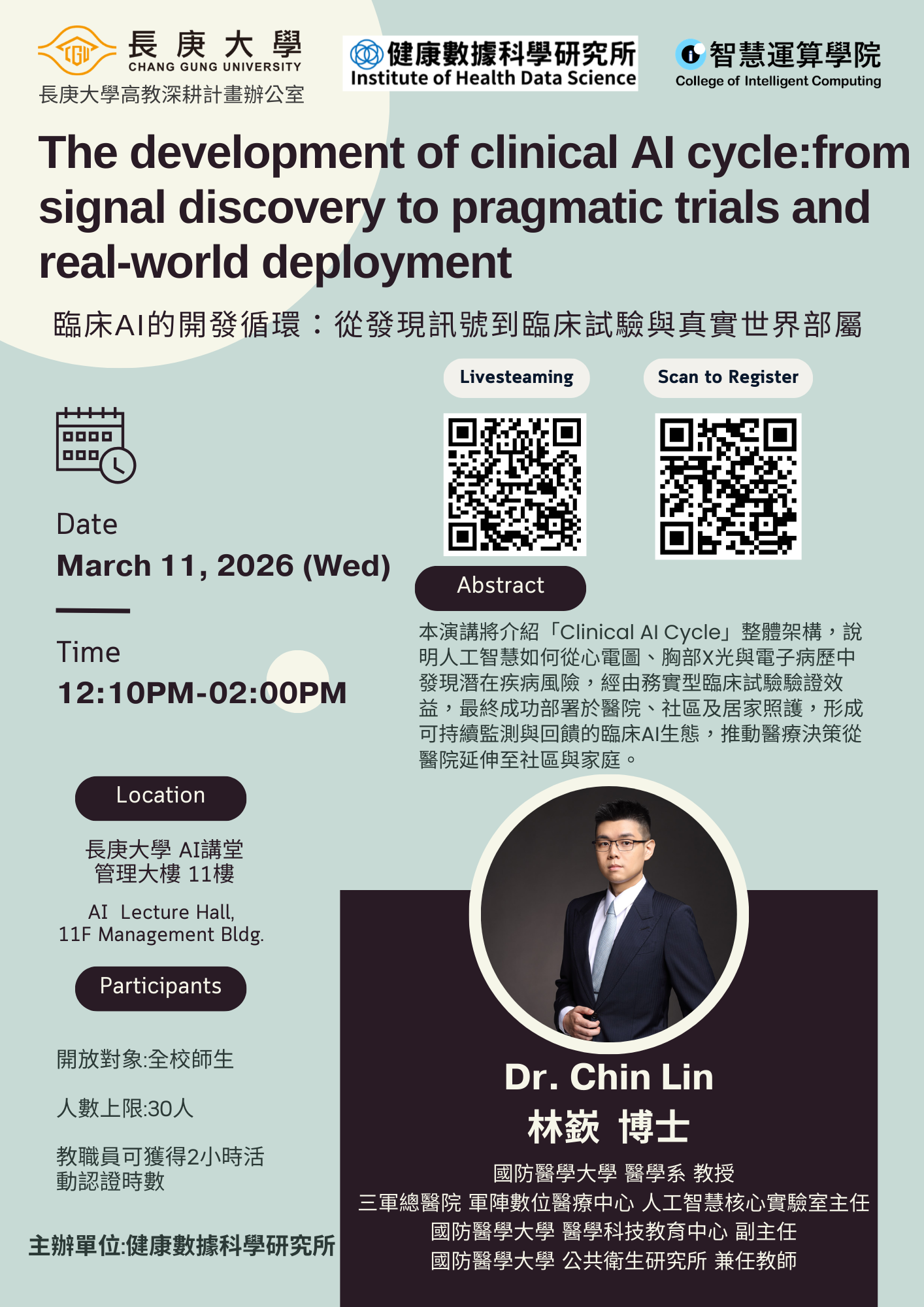
Topic: The
development of clinical AI cycle: from signal discovery to pragmatic trials and
real-world deployment
Speaker: Professor
Chin Lin, Department of Medicine, National Defense Medical University
Time: March
11, 2026 (Wednesday), 12:10 – 14:00 p.m.
Venue: The
Management Building, 11F, AI Lecture Hall or Livestreaming https://reurl.cc/GG72GG
Registration: https://reurl.cc/R9AMeD or scan QR code on poster
About the Speaker:
Dr. Chin Lin is a data scientist whose work
centers on establishing clinical evidence standards for medical artificial
intelligence. His research integrates large-scale electronic health records,
electrocardiography, medical imaging, and home-based sensing to develop AI
systems that are not only accurate, but clinically actionable and
outcome-improving. He has led or co-led more than ten pragmatic randomized
controlled trials evaluating AI-enabled clinical workflows, with results
published in Nature Medicine, NEJM AI, Radiology, and Nature Communications.
His team developed an AI-ECG platform that has received TFDA approval and USFDA
Breakthrough Device Designation, has been transferred to industry, and deployed
across multiple hospitals and rural screening programs. A central theme of his
work is treating AI not as a standalone model, but as a system-level
intervention that links prediction, clinical action, and patient outcomes
within real-world healthcare environments.
Abstract:
Recent advances in artificial intelligence
(AI) have shifted medical AI research from model-centric performance reporting
toward evidence-based clinical impact. In this talk, I introduce the concept of
the clinical AI cycle, a comprehensive framework that describes how clinical AI
can progress from signal discovery, through pragmatic clinical trials, to
real-world deployment in healthcare systems. At the stage of signal
discovery, I will illustrate how routinely collected data—such as electrocardiograms
(ECGs), chest radiographs (CXRs), and electronic health records (EHRs)—can be
leveraged using data-driven approaches and multimodal foundation models to
identify latent disease risks. This paradigm enables a single examination to
support opportunistic screening for multiple diseases, overcoming the
traditional one-test-one-disease limitation. The second stage focuses on
pragmatic trials, where AI models are evaluated not merely by predictive
accuracy but by their ability to trigger pre-specified clinical actions and
improve patient outcomes. By embedding AI alerts into real clinical workflows
and evaluating them using randomized controlled and digital trial platforms, AI
is positioned as an actionable decision engine rather than a passive prediction
tool. Finally, in real-world deployment, I will demonstrate how clinical
AI can be scaled to community screening, home healthcare, and wearable devices,
and integrated with large-scale health databases. This deployment completes the
clinical AI cycle, allowing continuous learning, post-deployment surveillance,
and discovery of new clinical insights.
Organizers: Institute of Health Data Science
※ Registration needed.