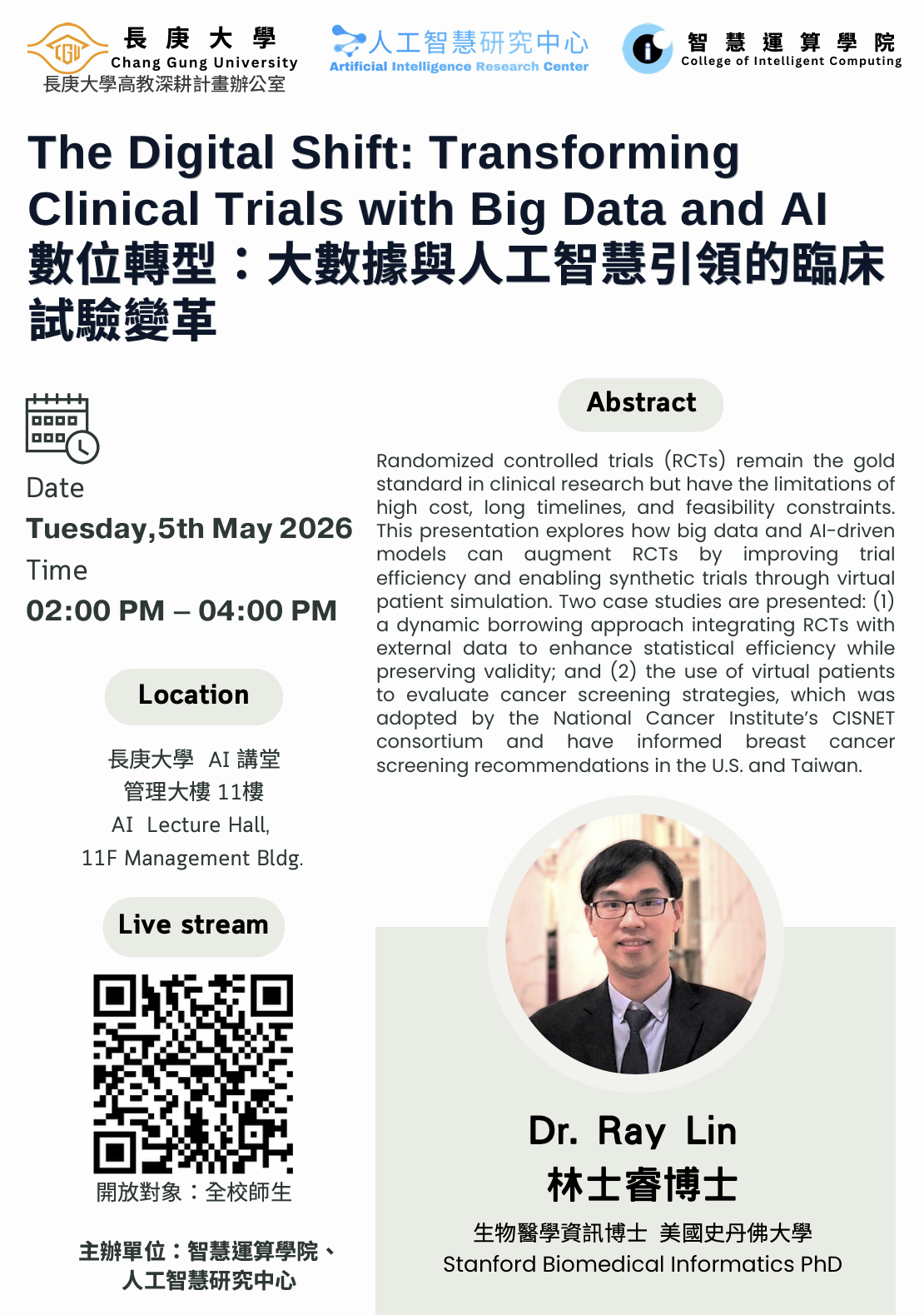

演講主題:數位轉型:大數據與人工智慧引領的臨床試驗變革
The Digital Shift: Transforming Clinical Trials with Big Data and AI
講者: 林士睿博士 美國Stanford 大學生物醫學資訊博士
PhD degree in Biomedical Informatics from Stanford University
時間: 2026年5月5日 (二) 14:00-16:00
地點: 管理大樓11樓-AI講堂
直播連結: https://reurl.cc/WbvX79或 掃描海報 QR code
講者簡介:
林士睿博士畢業於台大資訊工程學系/研究所取得學士和碩士學位,並在美國Stanford 大學完成統計碩士及生物醫學資訊博士學位。林博士對將人工智慧和資訊科技運用在生物醫學特別有熱忱。在Stanford時,他致力於透過電腦模型虛擬病人,運用模擬臨床試驗 ,以評估乳癌及肺癌篩檢的成效。之後林博士在羅氏藥廠 (Roche / Genentech) 從事癌症治療新藥的研發工作已有十五年,同時致力參與並領導跨領域的臨床醫學的研究合作。
Dr. Ray Lin got his BS and MS degrees in Computer Science and Information Engineering from National Taiwan University, specializing in AI in his Master’s Thesis. He later obtained a MS degree in Statistics and a PhD degree in Biomedical Informatics from Stanford University. His PhD research focused on synthetic clinical trials using computer-simulated virtual patients to evaluate cancer screening for lung cancer and breast cancer. Dr. Lin has accumulated 15 years of experience in drug development with Genentech (Roche) supporting clinical trials for developing new cancer treatments, including therapies approved in multiple cancer types globally. He has also been actively engaging in cross-industry collaborations and professional organizations, including multiple leadership positions in an American Statistical Association (ASA) scientific working stream, a US FDA initiated cross-pharma initiative in oncology, and the ASA San Francisco Bay Area local chapter.
演講大綱:
隨機對照試驗(RCTs)長期以來一直是臨床研究的最具可信度的研究方法;然而,這類試驗也面臨顯著挑戰,包括高昂成本、漫長的時程,以及倫理或可行性上的限制。大數據與人工智慧(AI)時代的到來,為解決這些難題提供了契機。透過整合試驗外的真實世界數據(Real-world data)——如電子病歷、保險資料庫及疾病登錄系統——可補足隨機對照試驗的不足,有效降低研究成本、提高受試者招募的可行性並縮短時程,對於急需醫療研究的罕見疾病尤為重要。同時,人工智慧驅動的模型能預測病患預後,並在傳統隨機對照試驗不可行性或違背倫理的情況下,透過模擬「虛擬病患」進行合成臨床試驗(Synthetic clinical trials)以評估干預措施。
本演講將分享兩個案例研究:(1) 提出一種創新的「動態借用」(Dynamic borrowing)方法,整合外部數據以提升研究效率,同時極小化選擇偏差並維持試驗的可信度;(2) 運用虛擬病患與合成臨床試驗評估癌症篩檢計畫的成效。相關研究結果已納入美國國家癌症研究所(NCI)的癌症干預及監測模型網路(CISNET),並實質影響了美國與台灣的乳癌篩檢建議指引。
Randomized controlled trials (RCTs) remain the gold standard for clinical research; however, they face significant hurdles, including high costs, lengthy timelines, and ethical or feasibility constraints. The era of Big Data and AI presents transformative opportunities to address these challenges. Real-world data (RWD)—such as electronic medical records, insurance databases, and disease registries—can supplement RCTs to reduce costs, enhance enrollment, and accelerate timelines, particularly for rare diseases with high unmet medical needs. Simultaneously, AI-driven models can predict patient outcomes, enabling the simulation of "virtual patients" in synthetic clinical trials when traditional randomization is impractical or unethical.
This presentation features two case studies: (1) A novel dynamic borrowing method that integrates RCTs with external data to increase study efficiency while minimizing selection bias and maintaining trial integrity; (2) The use of virtual patients and synthetic trials to evaluate cancer screening programs. These findings were incorporated into the National Cancer Institute’s Cancer Intervention and Surveillance Modeling Network consortium (CISNET) consortium and have directly influenced breast cancer screening recommendations in the U.S. and Taiwan.
※本活動無需報名