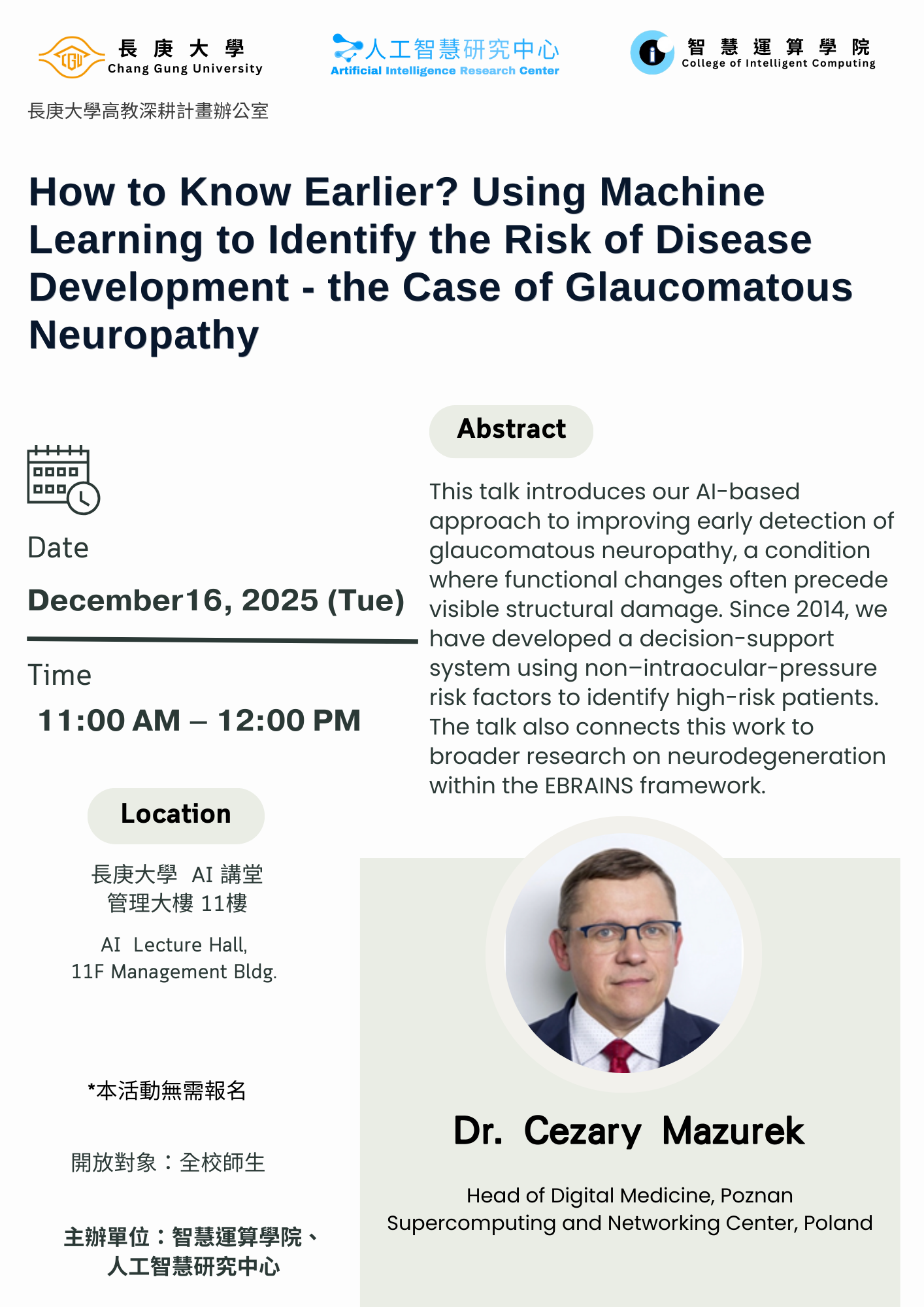

演講主題:How to Know Earlier? Using Machine Learning to Identify the Risk
of Disease Development - the Case of Glaucomatous Neuropathy
講者: Dr. Cezary Mazurek 波茲南超級電腦與網路中心
時間: 2025/12/16 (二) 11:00-12:00
講者簡介:
Dr. Cezary Mazurek, Computer Scientist, his professional activity has been
associated with the development of the Poznan Supercomputing and Networking
Center (PCSS) since its establishment in 1993. He served as CEO of PCSS from
2019 to 2024 and at that time he successfully brought it onto the path of
developing infrastructure and applications of quantum computing and AI, and is
now continuing this thread with a focus on applications in Life Sciences and
Personalized Medicine. For over 30 years, he has been involved in the
development of Polish and European e-infrastructure for science and is
currently one of the most experienced leaders in R&D projects, many of
which he has successfully implemented in practice. To date, he has led
development of more than 40 national and international R&D projects. His
R&D work has focused on integrating various specialized software components
into consistent systems for digital science with emphasis on software
governance. In recent years, he has been involved in the development of domain
research infrastructures, such as for digital humanities, as well as for
personalized medicine.
Cezary’s scientific activities mainly focus on
applying machine learning methods for early detection of disease development
mechanisms. A solution led by him to support pre-symptomatic diagnosis of
glaucoma development using machine learning received patent protection from the
Japan Patent Office in 2023 and from European Patent Office in 2025. He is
currently extending his interests to advanced methods of data collection and
analysis in a digital twin model. He is author or co-author of over 100 papers
in professional journals and conference proceedings. Since 2020 the President
of Wielkopolska ICT Cluster. Since 2023 the member of GÉANT Association Board
of Directors. In 2024 he initiated the establishment of a national consortium
EBRAINS-PL and became the member of EBRAINS National Node Board. IEEE Senior
Member, member of IEEE Computer Society as well as IEEE Computational
Intelligence Society.
演講大綱: In recent years, there has been a significant increase in
the number of studies on the role of artificial/assisted intelligence in the
diagnosis of eye diseases. Scientific work in this field is mainly based on the
analysis of imaging examinations. However, the development of diseases is very
often caused by functional disorders that remain hidden for many years and are
not immediately visible in the form of clinical symptoms. An example of such
diseases is glaucomatous neuropathy. Since 2014, we have been working in a
transdisciplinary team on intelligent decision support technology in the
functional diagnosis and treatment of glaucomatous neuropathy. The
functionality of the developed software platform is based on the assessment of
non-intraocular-pressure risk factors in the development of glaucomatous
neuropathy, enabling glaucoma specialists to be supported in the recognition,
quantification, and differential diagnosis of glaucomatous neuropathy. The
developed system, based on a predictive model, enables the identification of
individuals with ocular hypertension at significantly high risk of conversion
to primary open-angle glaucoma, as well as the assessment of the effectiveness
of glaucoma therapy. The solution has been patented in Japan and Europe.
The above example
shall also help to present the latest trends in our research work on
neurodegenerative diseases and brain health initiated around the EBRAINS
research infrastructure, artificial intelligence, and quantum computing
technology.
主辦單位:智慧運算學院、人工智慧研究中心
※本活動無需報名