

Giant 17 (2024), 100227
Advancing
the performance and stability of lithium metal batteries is crucial for
future energy storage devices. One of the major challenges for
practical applications of Li metal batteries is to mitigate the
formation of Li dendrites during cycling. In this work, we prepared a
series of asymmetrically structured polyethersulfone (PES) membranes,
consisting of a nanoporous skin layer and a bulk with macrovoids,
by incorporating different amounts of glycerol during membrane
preparation. Under optimal conditions, the asymmetric PES membrane made
with 1.2 wt%
of glycerol (PES-G1.2) possesses a thin skin layer with a
uniform nanopore distribution, which is ideal for regulating the ion
flux near the Li anode surface, thus suppressing Li dendrite formation.
Our results demonstrate that the PES-G1.2 possesses exceptional ionic
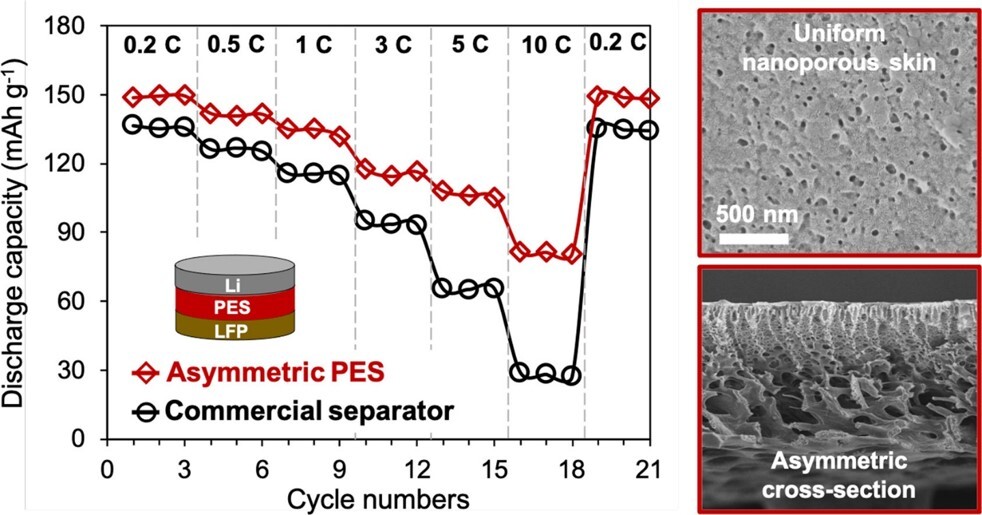
conductivity of 1.76 mS cm−1, Li+ transference number of 0.52, and high compatibility with Li electrode. Additionally, the Li/PES-G1.2/LiFePO4 cells also present a remarkable rate capability with specific capacity of 150 mAh g−1 at 0.2 C and 81 mAh g−1 at
10 C, respectively, and 90 % of capacity can be retained after 100
charge-discharge cycles under 0.2 C. These findings shed light on the
unique properties of asymmetric porous membrane as well as its promising
potential for applications in lithium metal batteries.