Development of Interphase-Engineered Poly(butylene succinate)-Rich Bionanocomposites Reinforced With Carbon Nanotubes for Improved Structural and Functional Properties
ABSTRACT
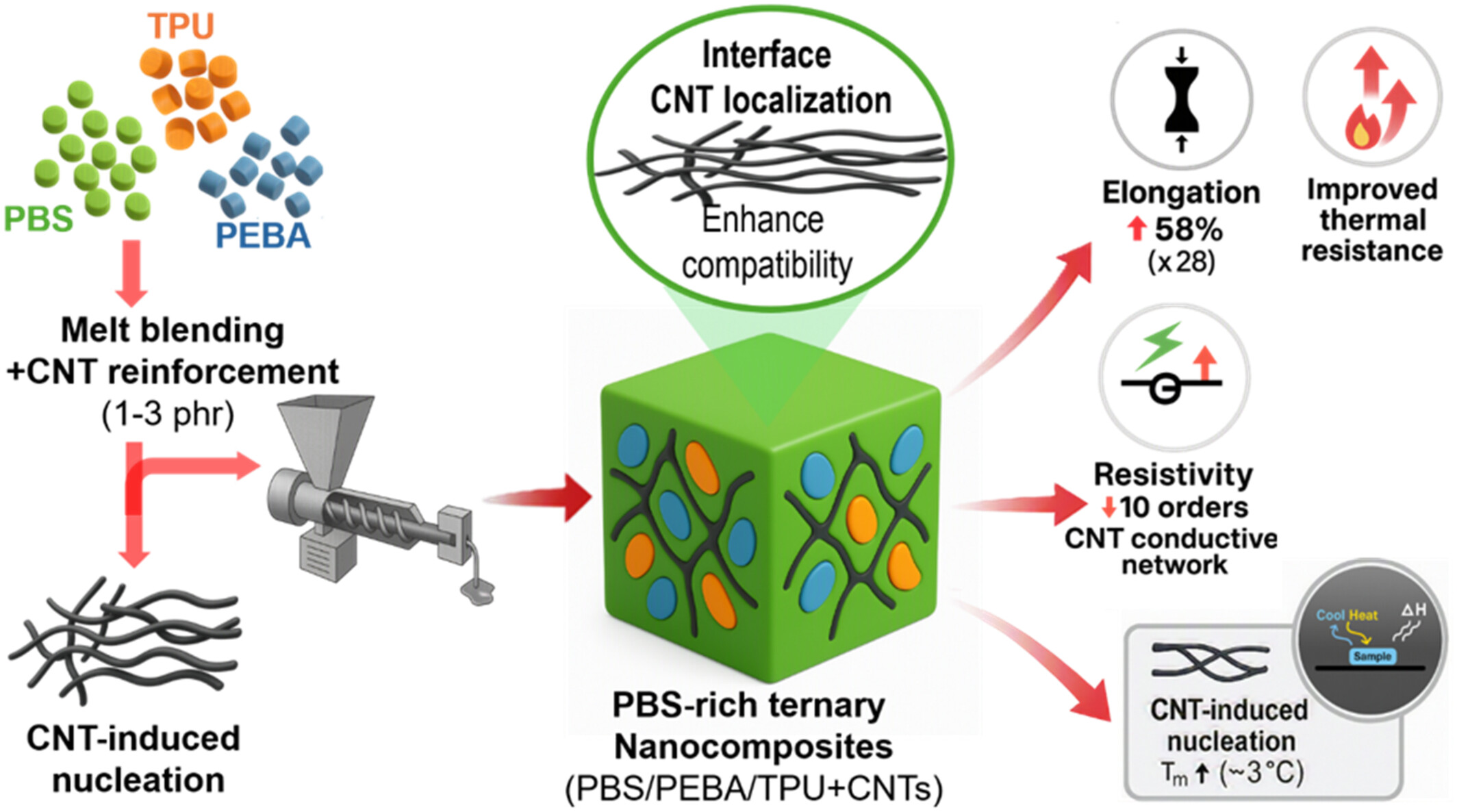
Poly(butylene succinate) (PBS) is a promising biodegradable polyester, but its broader application is limited by low toughness, slow crystallization, and poor thermal stability. Here, a PBS-rich bionanocomposite system was developed through dual-elastomer toughening and low-loading carbon nanotube (CNT) reinforcement. PBS was melt-blended with bio-based poly(ether-block-amide) (PEBA) and thermoplastic polyurethane (TPU), followed by incorporation of CNTs (1–3 phr), resulting in significant improvements in mechanical, thermal, electrical, and rheological properties. Microscopic observations revealed preferential CNT localization at PBS/PEBA/TPU interphases, leading to improved phase compatibility and interfacial adhesion. CNTs acted as nucleating agents for PBS crystallization and increased the melting temperature by up to 3°C. Compared with the unfilled blend and neat PBS, the composite containing 3 phr CNT exhibited increases of 45°C and 24°C, respectively, in the temperature at 20 wt% weight loss. The optimized CNT-reinforced composite exhibited an elongation at break more than five times higher than that of neat PBS while maintaining moderate stiffness. Electrical resistivity decreased by ~10 orders of magnitude owing to the formation of conductive CNT pathways. Rheological analysis indicated increased viscosity and elasticity, confirming enhanced interfacial interactions. These findings demonstrate a scalable approach for producing PBS-rich bionanocomposites with enhanced toughness, thermal stability, and electrical conductivity.