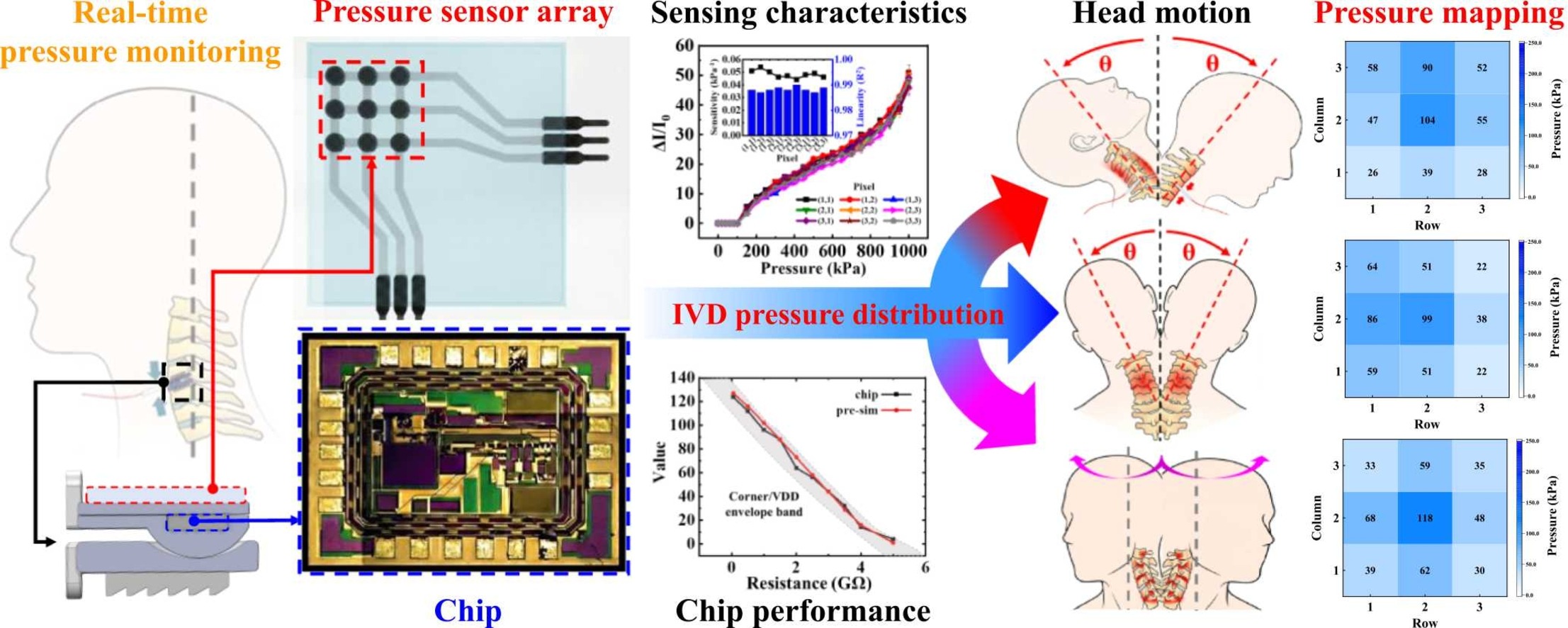
Smart artificial cervical intervertebral disc system with a 3×3 PANI:PEO piezoresistive pressure sensor array and self-designed readout circuit for real-time intradiscal pressure monitoring
Jer-Chyi Wang, Ying-Ching Li, Kuan-Lin Chen, Hung-Pin Lin, Min-Wei Chen, Shao-Ku Kao, Yau-Zen Chang, Yu-Jen Lu*
Sensors and Actuators A: Physical, https://doi.org/10.1016/j.sna.2026.118641
Abstract
Cervical disc replacement is increasingly implemented to restore segmental motion after disc degeneration. However, the postoperative intradiscal biomechanics of the implanted prosthesis remain unobservable between follow-up visits, leaving early failure modes such as subsidence, migration, endplate microfracture, and facet overloading undetected until they become radiographically or symptomatically evident. Herein, a smart artificial cervical intervertebral disc is proposed, which integrates a flexible 3×3 polyaniline:polyethylene oxide (PANI:PEO) piezoresistive pressure sensor array with a self-designed 0.18-µm CMOS readout application-specific integrated circuit (ASIC) for real-time intradiscal pressure monitoring. The sensor array exhibited a strictly monotonic piezoresistive response up to 1000 kPa with a pixel sensitivity of 0.034–0.040 kPa−1, thus fully encompassing the physiological cervical loading range. The ASIC directly resolved gigaohm-level impedances (0.05–5 GΩ) with one order of magnitude above Wheatstone-bridge-based architectures and delivered a 7-bit on-chip digital output through a resistance-to-voltage converter, voltage-controlled oscillator, frequency-to-digital converter, and amplitude-shift-keying modulator within a total die area of 0.703×0.863 mm2 at 79 MHz for 117.81 mW. The fully integrated prosthesis was implanted in a human-shaped head-and-neck phantom and successfully resolved the characteristic load-transfer patterns across the three principal anatomical planes, capturing anterior/posterior peaks of 90–94 kPa under sagittal flexion/extension, ipsilateral peaks of up to 101 kPa under coronal lateral bending, and concentric central-core stress of 110–118 kPa under transverse axial rotation. The proposed platform successfully converts a passive prosthesis into a continuously self-reporting sentinel and lays the groundwork for intelligent and self-monitoring cervical disc implants.