Self-powered self-healing piezoelectric hydrogel nanogenerator-based
electronic skin for real-time handwriting recognition and Morse code
communication
Ragu Sasikumar, Palraj Ranganathan,
Bhuvanenthiran Mutharani, Fang-Chyou Chiu*
& Byungki Kim*
Advanced Composites and Hybrid Materials, https://doi.org/10.1007/s42114-026-01981-7
Abstract
Skin-conformal human–machine interfaces
that operate reliably under mechanical deformation and harsh environments are
essential for next-generation wearable electronics, defense systems, and
Internet of Things (IoT) platforms. Here, a resilient and stretchable flexible
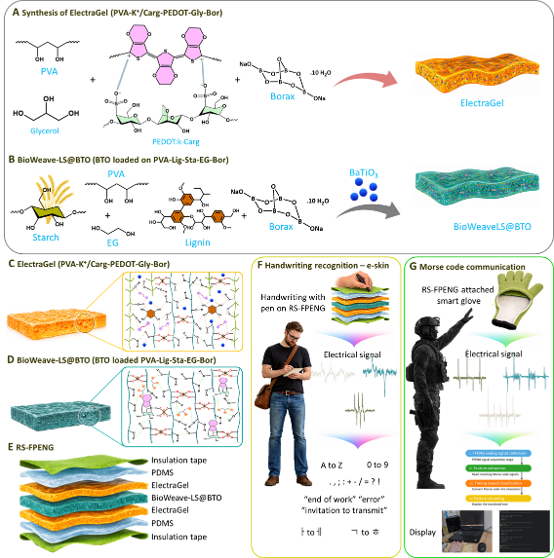
piezoelectric nanogenerator (RS‑FPENG) is
reported that seamlessly integrates self-powered sensing and energy harvesting
within a dual-hydrogel architecture. The device combines a highly conductive,
self-healing ElectraGel electrode with a bio-derived BioWeave‑LS@BaTiO3 piezoelectric core featuring a dynamically reversible
multibond network, enabling exceptional mechanical compliance, environmental
tolerance, and interfacial stability. The RS‑FPENG delivers a peak output voltage of ~1.15 V, representing a ~
4.6-fold improvement over conventional PDMS-based FPENGs, with a maximum power
density of 8.48 µW m⁻2, fast response (~120 ms), high linearity (R2 = 0.9738),
and a sensitivity of 4.15 × 10⁻3 V g⁻1 across an ultrawide force range
(0.01–883 N). Stable electromechanical performance is retained under broad
humidity, temperature, and chemical conditions. Beyond energy harvesting, the
RS‑FPENG enables self-powered detection
of complex biomechanical motions and supports multilingual handwriting recognition
and Morse code communication with real-time decoding. This work establishes a
robust materials platform for environmentally resilient, battery-free wearable
interfaces and intelligent assistive IoT systems.