Unconstrained Coordination of Pt Single Atoms on Distorted g-C3 N4 Enables Electronic Flexibility and Enhanced Microplastics Photoreforming
Ting-Han Lin, Yin-Hsuan Chang, Jia-Mao Chang, Ciao-Yun Huang, Kai-Chi Hsiao, Kuo-Ping Chiang, Ying-Han Liao, Kai-Hsiang Hsu, Jen-Fu Hsu, Ming-Chung Wu*
Advanced Science, https://doi.org/10.1002/advs.76070
Abstract
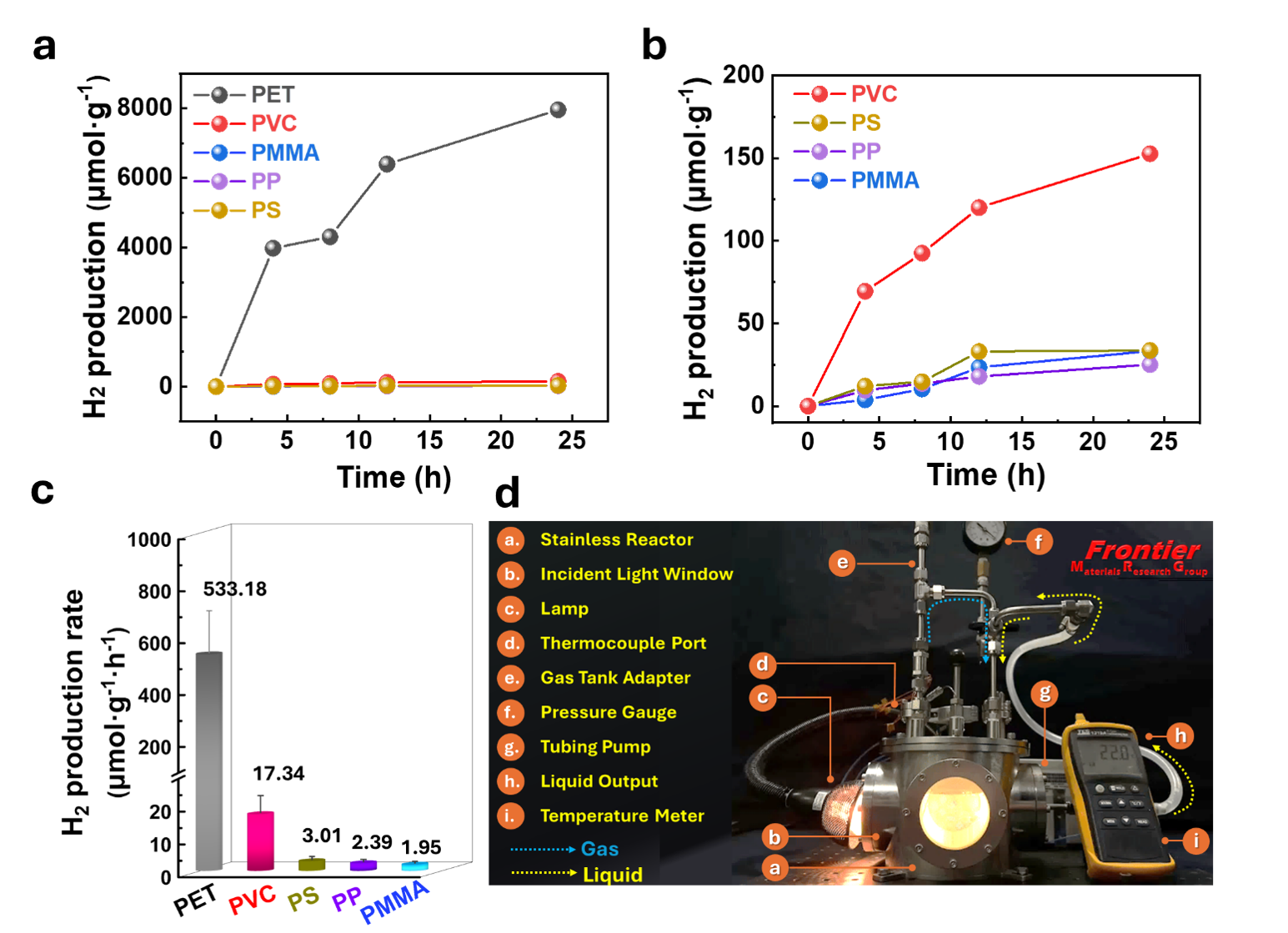
The accumulation of microplastic waste has raised growing environmental concerns, motivating the development of sustainable strategies for plastic-to-fuel conversion. Here, we report a platinum single-atom catalyst anchored on distorted graphitic carbon nitride (Pt1 /CN) for efficient photocatalytic microplastics photoreforming. Unlike conventional planar g-C3 N4 models, the locally distorted heptazine framework introduces off-plane coordination environments that enable unconstrained Pt ─N coordination and promote electronic flexibility. X-ray absorption spectroscopy reveals Pt ─N coordination associated with distorted heptazine units, where distortion-induced charge localization enhances interfacial electron transfer to Pt sites. In situ measurements under light irradiation further confirm efficient charge transfer at the Pt1 /CN interface. Among various microplastics, polyethylene terephthalate (PET) exhibits the highest hydrogen evolution rate of 533.18 μmol ⋅g− 1 ⋅h− 1 , attributed to alkaline-assisted ester bond cleavage. Density functional theory calculations demonstrate that Pt single atoms facilitate hydrogen evolution by lowering H+ reaction barrier and stabilizing key intermediates. This work elucidates the structure–activity relationship of Pt1 in polymeric semiconductors and establishes a framework-level design strategy for electronic flexibility in photocatalytic plastic-to-fuel conversion.